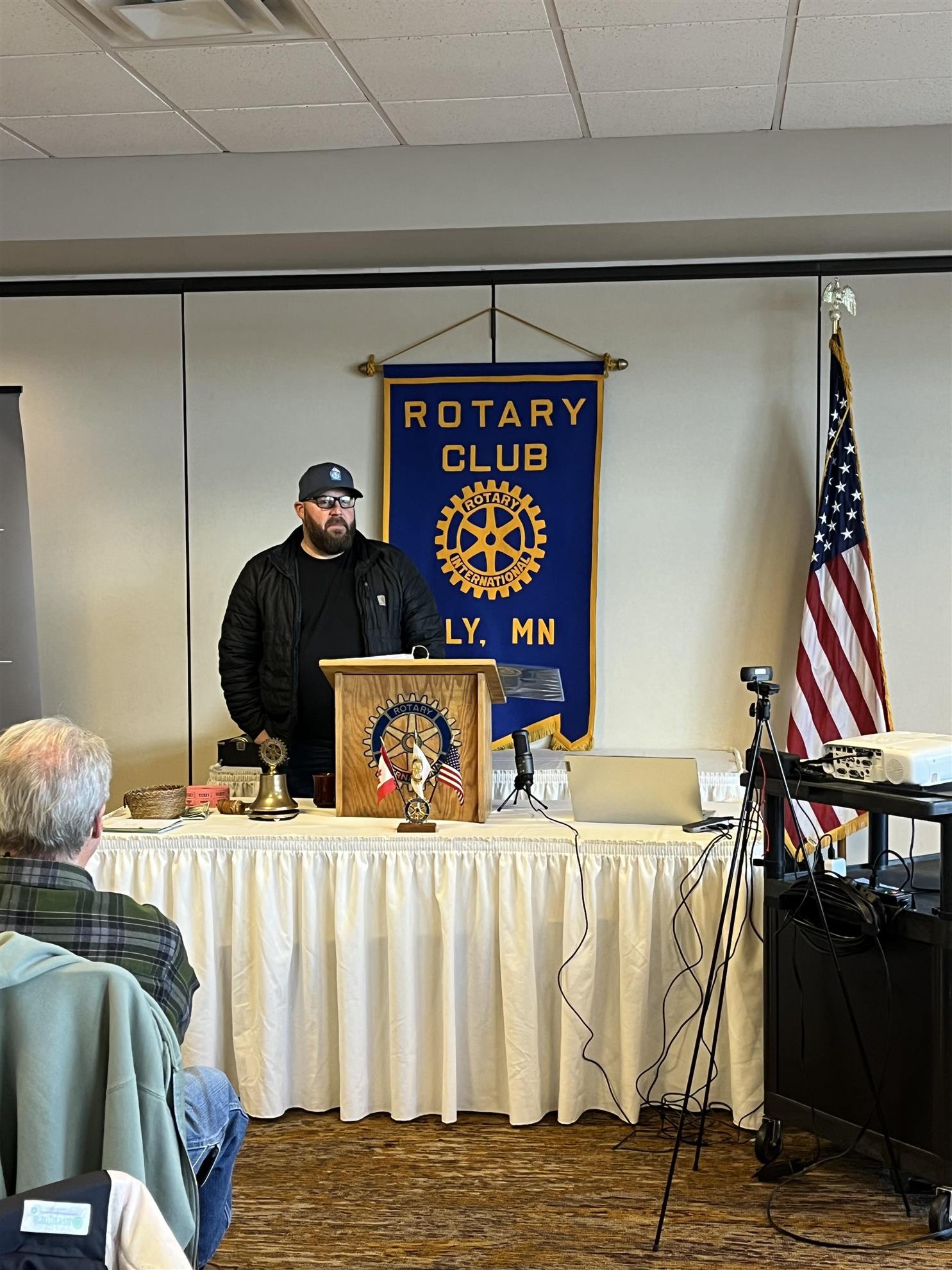
Aaron Kania is the US Forest Service District Ranger for the Kawishiwi District of the Superior National Forest. He has a wide ranging background in public land management out west with the National Park Service and the Bureau of Land Management having served for 23 years as a law enforcement ranger. He worked extensively in wilderness stewardship. He has worked in Ely since 2020.
His role is to supervise Rangers in the district, plan the work that needs to be done, and be the one where the buck stops at the local level. The District Ranger interacts with elected officials and community leaders to inform them of ongoing work and to coordinate efforts on issues of mutual interest.
He started his career in Bryce Canyon National Park. He worked in Utah for about eight years and Wyoming for 10 years. He used to come to the BWCA when he worked in Wyoming. Aaron arrived in Ely May 2020 during the height of the pandemic.
The SNF is about three million acres in size. Aaron covers the middle section. There are five districts with the headquarters in Duluth.
Aaron welcomed the open invite to talk about how everything happening in Ely intersects with the Superior National Forest (SNF). He used the opportunity to research the uniqueness of Ely.
He talked about being approached by a community leader and being asked if we can possibly expand the scope of other things happening in our community beyond tourism. Aaron did a lot of research before moving to Ely to learn about the community, the area and the job he was entering.
He looked at the trends of the permits. The volume was trending down, the average age was trending up and the numbers in groups was shrinking. Prior to the pandemic there were concerns about the use of the BWCA going down.
The example he uses from his experience is Moab, Utah and how they turned around the population downturn. The Arches are the draw, they had a resource based economy, ranching and mining. There were changes in the economy in 1990's and the population dropped 25%. The community worked hard to diversity their recreation economy into Jeep off roading (now ATV's/UTV's mountain biking and river activities. The Colorado River runs through the area. There are daily guided kayaking trip and other river activities available. There has been a shift in population up 20% by 2000 The economy and the population continues to grow. The value of houses has continued to go up along with the rise in population.
Comparing Moab’s dynamics to Ely, and BWCA permit trends with mining, timber and tourism historically driving the economy: The peak population was in 1930 at around 6,000. In 2020 the population according the Census was about half of the peak.
Note: There was an increase in permits in 2020 during the pandemic. That has peaked and is trending down but not to pre-pandemic numbers.
Things Ely has in place to diversify that stand out to visitors:
- The expanded ATV trails have had a huge impact on the economy. The University of Minnesota County Extension published an economic impact study. 220,000 people are using the trails in northeastern Mn with an economic impact of $23 million according to the study. (Link to study: https://extension.umn.edu/community-research/atv-trails-koochiching-lake-and-st-louis-counties )
- Mesabi Bike Trail with recent links to Ely, Eagles Nest and Tower - 180,000 people are using the trails.
- Hidden Valley mountain bike trails are top notch having biked in Utah. This use has grown also.
- The North Country Scenic Hiking Trail under development with a chapter opening here in Ely. (We had a speaker from the chapter at Rotary a few weeks ago.)
- The BWCA is one of a kind. (A bit biased) There is no other place like it where people can go out in a canoe into a wilderness for any length of time they would like. There are dark skies, northern lights, Milky Way, it is quiet, (few high altitude commercial airline traffic unlike out west) unique forests (boreal, Cathedral Pines), and wild life mix.
- The quality of Ely itself. Diversity of lodging that is unique to this area. There are other things people can do while here if they are not recreating. The aesthetics of downtown like the murals are inviting, restoration of older buildings, flowers all over town, it is neat and clean.
- The summer festivals and the friendliness of people in Ely. The quality of sleep when people visit because of the quiet. We have the winter sports, dog sledding, skiing, extreme cold (that's a thing for some people).
- All of this is unique to Ely.
Linking back to the Forest Service. The Forest Service has a special role and decisions impact Ely. The Forest Service's job is to protect the resources. Forest Service decision making considers the landscape and protecting the resource that is here.
Summary: Ely stands out to people around the world for its uniqueness and qualities. Assuming increasing population is of interest to the community it takes exchanging ideas, making connections and protecting all that is unique to Ely. It is a challenge for leaders in the community to maintain and improve quality and protect Ely’s uniqueness.
Audience question: How did Moab solve the differences between preferences of quiet vs motor sports activities? Answer: This is where the broader picture comes in to think about impacts and sticking points. Seeking public input and coming up with alternatives and going back out for more input, so it's not one entity making the decision and alternatives are considered in the decision making. It’s not perfect, but it is what was used in Moab.
Question: How many permits come through Ely? Roughly 13,000. So it is the busiest wilderness in the country, busiest district in the country and the busiest entry points like in the country, with Moose, Lake and Lake One, etc.
If you need help with permits see an outfitter or stop by the Forest Service.
Thank you to Aaron for spending time with us to learn more about the Forest Service role, Aaron himself and his investment in being part of our community and all that he and others find stand out in the uniqueness of Ely.
For more information:
https://www.fs.usda.gov/
AaronKania@usda.gov

.png)